The story seems an improbable fiction: a famous Hollywood actress invents a secret technology so far ahead of its time that it takes decades for the full potential of her idea to be recognized. Yet in 1941, actress Hedy Lamarr, collaborating with pianist George Anthiel, invented frequency-hopping, spread-spectrum technology. The concept they pioneered is fundamental to wireless technologies including GPS, WiFi, ultra-wideband (UWB), and cellular communications.

Now Richard Rhodes, Pulitzer Prize-winning author of The Making of the Atomic Bomb, turns his sights on this fascinating story. Rhodes’ Hedy’s Folly: The Life and Breakthrough Inventions of Hedy Lamarr, the Most Beautiful Woman in the World provides a detailed look at the life and times of Hedy Lamarr and her collaborator, pianist George Antheil, with whom she invented a novel frequency-hopping torpedo control system, pioneering what came to be known as “spread-spectrum” technology.

At age 18, Hedy Keisler starred in Ecstasy, a controversial 1933 movie that included a nude swimming scene and a sex scene. She adopted the stage name "Hedy Lamarr" at the insistence of Louis B. Meyer some years later. Source: Wikipedia.

Hedwig Kiesler was born in Vienna, Austria, in 1913. She dropped out of school at age 16 to become a professional actress. She became famous at age 19 for her role in the controversial film, Ecstasy. The film featured a nude swimming scene as well as a sex scene, although that latter scene only depicted the actors’ faces during the act. That same year she married Friedrich Mandl, a Viennese arms merchant who disapproved of his wife’s acting career. He not only tried to acquire all the prints of Ecstasy (at a reported cost of $300,000), but also kept his young wife a virtual prisoner in their home. Hedy entertained business clients and customers of her husband’s arms company, Hirtenberger.

Hedy never specified in detail which German technological advances she heard discussed over luncheons and dinners in the Mandl mansions, but there was much to hear…. Certainly Hedy listened closely to discussions of submarine and aerial torpedos, weapon systems for which Hirtenberger was supplying components. [p. 97]

Hedy spent the winter of 1936-1937 in Switzerland where she struck up a relationship with the novelist Erich Marie Remarque. [pp. 105-106] Rhodes credits Remarque as a guide or mentor for Hedy in her decision to leave her husband. She and Mandl filed for divorce in 1937. Hedy claimed to have disguised herself as her maid in order to escape from her husband and make her way to London. There, she met Louis B. Mayer, head of the MGM Studio. Hedy rebuffed Mayer’s initial offer, but traveled to America on the same liner with Mayer and his wife. After several more discussions, she accepted a seven-year contract with MGM. Mayer insisted, however, that she change her stage name to “Hedy Lamarr,” [reminiscent of actress Barbara La Marr who died of tuberculosis in 1926] at the suggestion of his wife [pp. 109-112].

Hedy Lamarr arrived in Hollywood in October 1937. She worked diligently, learning English, dropping her already slim 125 pounds down to 110, and landing a starring role opposite Charles Boyer in Algiers.

Hedy became a full-fledged Hollywood star. The turbans she wore in the film started a new fashion among American women. Other Hollywood actresses, previously blond, dyed their hair black to match hers, and as she did, began parting it in the middle [p. 115].

Hedy made a few films a year requiring a month or so of shooting each, so she had plenty of time on her hands. She turned to inventing as a hobby.

One way Hedy occupied her spare time was inventing…. “Howard Hughes once lent her a pair of chemists,” Forbes Magazine reports, “to help her develop a bouillon-like cube which, when mixed with water, would create a soft drink similar to Coca-Cola. ‘It was a flop,’ she says with a laugh.” Her daughter, Denise, remembers a tissue-box attachment Hedy invented for disposing of used tissue. Hedy invented to challenge and amuse herself and to bring order to a world she thought chaotic.  [p.116]

As the world lurched into war and submarines menaced the Atlantic, Hedy began thinking how to invent a remote control torpedo. That led her into a collaboration. Although Hedy Lamarr headlines Rhodes’ work, his story also delves deeply into the background of her collaborator, pianist and composer George Antheil. The self-proclaimed “Bad Boy of Music,” developed a reputation for his avant-garde compositions. His most notorious work, “Ballet Mècanique,” featured pianos, percussion, electric buzzers and airplane propellers. Here’s a sample:

Antheil attempted (unsuccessfully) to synchronize sixteen player pianos for this work. Eventually, he succeeded in a 1927 Carnegie Hall performance with four synchronized pianos [p. 153]. Antheil necessarily became expert at synchronization and control. He brought these skills to bear in his collaboration with Lamarr.

When Marconi was first asked in 1902 about the application of wireless to warfare he confidently claimed an adversary could never guess the frequency [see RTLS: Direction-Finding Goes to War]. But as early as the First World War, interception, direction finding, and jamming were all part of warfare’s wireless landscape. Signal security in wireless systems was a major concern – how to keep the enemy from figuring out the frequency being used and jam, or worse commandeer, the signal. Hedy may have heard about German efforts to employ multiple frequencies in radio controlled glide bombs at Mandl’s dinner parties, or may have been inspired by a wireless remote control for a Philco radio [p. 144]. A system that can potentially use multiple frequencies is more difficult to jam than one which always uses the same frequency. Hedy took the idea one step farther, however. Instead of a system that operated on one of a number of frequencies, Hedy proposed a system that jumped in a pseudo-random fashion among a set of frequencies, i.e. “frequency-hopping.”

But the challenge in frequency-hopping lies in synchronizing the transmitter and the receiver so that the receiver is listening to the exact same frequency used by the transmitter. That’s where George Antheil’s contribution came in. Antheil took Hedy’s idea and reduced it to practice. He envisioned a paper tape selecting the various RF tones in the frequency-hopping system exactly analogous to the way in which a player piano selects keys to reproduce a desired melody. Starting the two tapes at the same time and running the tapes at the same speed would ensure that both ends of the link remained synchronized. The two received U.S. Patent 2,292,387 for their invention.

The first spread-spectrum RF system was proposed by Hedy Lamarr and George Antheil. U.S. Patent 2,292,387.

Rhodes explains how the system was to work:

Antheil waggishly affirmed a range of up to eighty-eight frequency hops for the system, the number of keys on a piano – a musician’s sly autograph.

With a signal hopping all over the radio spectrum, and doing so not regulalry but arbitrarily, more or less at random, the transmission would be impossible to jam because an enemy would be unable to follow it. He might accidentally jam one frequency if the signal happened to hop there, but with a potential for hundreds of hops per minute, the transmission would lose very little information from such minor interference. Anyone listening on a single frequency would not even realize a signal was being transmitted, since he would hear, at most, only an occasional brief blip.

To make jamming even more difficult, George and Hedy proposed using seven tuning condensers [capacitors] on the transmitter, but only four on the receiver. Three of the transmitter channels would thus send a false signal, one with no operating function, further complicating any effort to determine which transmissions to jam [pp. 173-174].

Unfortunately the Navy’s torpedo program was plagued by technical difficulties. Having difficulty making basic torpedos work reliably, the Navy showed no interest in adopting Lamarr’s and Antheil’s innovative concept [p. 185]. The inventors were hindered by the impression that they were advocating a player piano mechanism be embedded in a torpedo guidance system, instead of that being one specific way to implement the more general concept [p. 152]. Although the Navy formally rejected their idea, it did acquire rights to the patent. The details remain cloaked in secrecy [p. 187-188]. Further, the Navy kept the invention secret for the next forty years.

A decade later, the Navy contracted with Hoffman Laboratories to develop a sonobuoy using Hedy’s and George’s idea, although the project was not ultimately successful [pp. 194-197]. The patent expired, still secret, in 1959. That same year, George Antheil died at age 58, never having any formal recognition of his accomplishment [p. 202].

Rhodes deftly describes the life and times of both Hedy Lamarr and her collaborator, George Antheil. He provides a fascinating discussion of the technical landscape within which their invention took place from hydrogen peroxide torpedo propulsion to radio control and frequency hopping. I was particularly impressed with his clear and cogent discussion of the process of invention and the nature of patents.

Invention is a challenging business. As with Hedy Lamarr’s and George Antheil’s invention of frequency hopping, an idea can be so far ahead of its time as to prevent immediate adoption. Even the greatest ideas can fail if the enabling technology is too immature, the market need is insufficient, or societal forces prevent adoption. A few that come to mind include:

I went looking for more and came across Innovation News Daily’s interesting list that captures two of my three and adds eight more inventions that were ahead of their time. Although Hedy Lamarr never profited from her invention, she did live long enough for her contribution to be recognized in her lifetime. In 1997, the Electronic Frontier Foundation honored the eighty-three year old actress with their Pioneer Award. She died in 2000 at the age of eighty six.

Acknowledgement: Random House was kind enough to send both a bound galley and an early release version of the book. Thanks!

For More Information:


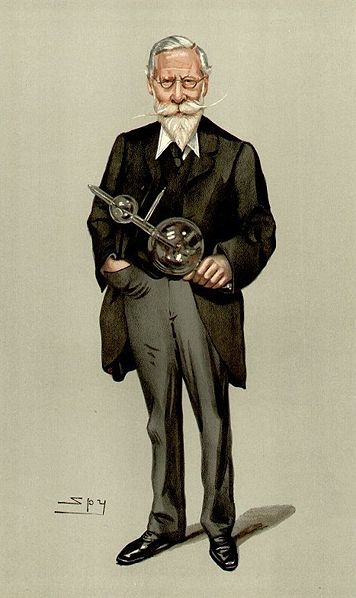
Sir William Crookes, pioneer in vacuum tube technology and early radio visionary. Courtesy Wikimedia.

In his guest post last week, The Rise and Fall of UWB, Kai Siwiak traced the history of wireless – from the original wideband spark transmissions, to narrowband carrier signals with compact modulations, coming full circle back to spread spectrum and ultra-wideband signals. This history is correct in its description of wireless technology, yet overlooks the stated motivations and goals of early wireless practitioners.

Early radio was actually narrow band in conception, and UWB in practice solely due to the limitations of RF technology. This narrow band thinking manifests clearly in an article by vacuum tube pioneer and early radio visionary, Sir William Crookes.

Continue reading »


AetherCzar is grateful to Dr. Kai Siwiak for his comment provoking guest post on ultra-wideband (UWB) technology. In thanks for his contribution, we’d like to draw our readers’ attention to Kai’s excellent introductory UWB technology text (by way of a review originally posted at Amazon.com).

Kai Siwiak and Debra McKeown’s Ultra-wideband Radio Technology offers a very readable and easy to understand introduction to UWB technology accesible to technologists, technical writers, and business people who may not have a deep background in RF or communications theory. At the same time, the book covers all the essentials needed by RF engineers and other specialists who may be bringing their expertise to bear on UWB for the first time. It’s a difficult act to walk the tightrope between a book accessible to a general audience and a book useful to technical readers, but this collaboration between an accomplished Florida based RF engineer and a talented Kenyan (now Nashville-based) teacher presents a well balanced composition with considerable style and grace.

Continue reading »

Jun 012010
 

The 1942 frequency-hopping spread spectrum invention (US Patent 2,292,387) issued to H.K. Markey (Hedy Lamarr) and George Antheil exemplifies the variety of wide band signaling. Image Copyright © D. McKeown and K. Siwiak, 2003-2010. Used with permission.

Guest Post by Kai Siwiak, TimeDerivative, Inc.
Unless otherwise indicated, all quotes are from: K. Siwiak and D. McKeown,
UWB Radio Technology, (Wiley, 2004)

We pause to reflect on the rise and fall of ultra-wideband (UWB) technology, and especially on the recent reorganization of Time Domain Corporation, a UWB pioneer company that has fallen on tough times. UWB radio coincides with the birth and original rise of wireless technology. We’d have to start with spark gap Morse code transmissions (which actually used Vail’s dot-dash code) using Class B damped wave emission.

Continue reading »

© 2010-11 Hans Schantz except as noted. Suffusion theme by Sayontan Sinha

Switch to our mobile site