I’ll be presenting a paper, “On the Origins of RF-Based Location,” at the 2011 IEEE Radio and Wireless Symposium this morning at 8:00 in room Cira A. The paper collects together the pre-WWII material I’ve blogged about under the History of RF-Based Location category here at ÆtherCzar.

This paper will provide a brief survey of the origins of RF-based location technology through the beginning of the Second World War. Direction finding (DF) was invented by John Stone Stone in 1902 and improved upon by Lee de Forest, Ettore Bellini and Alessandro Tosi. Both radar and amplitude ranging date to 1904, although these concepts were in advance of the ability of RF technology to implement. DF played a critical role in the First World War, most notably in the naval Battle of Jutland. The requirement for accurate night-time direction led classicist and cryptographer Frank Adcock to invent an improved DF system. In the 1920’s, DF and related concepts came of age for civilian applications like navigation. Inventors of the period introduced a variety of other techniques were introduced including time-of-flight or transponder ranging. By the time of the Second World War, DF was a mature field and additional novel RF-based technologies were ready to be developed.

In a second paper (not accepted by the conference) – “RF-based Location Technology Since World War II,” I present additional material. This second paper presents a brief historical overview of RF-based location technologies since the Second World War. Although direction-finding (DF) was critical to the Allied victory over German U-Boats in the north Atlantic, this paper focuses on more recent RF-based location technologies including Time-Difference of Arrival (TDOA), and ultra-wideband (UWB) technologies. More recent advances, including satellite navigation, RF fingerprinting, and near-field electromagnetic ranging technologies are also considered.

My presentation this morning will actually cover material from both papers.

Jun 292010
 

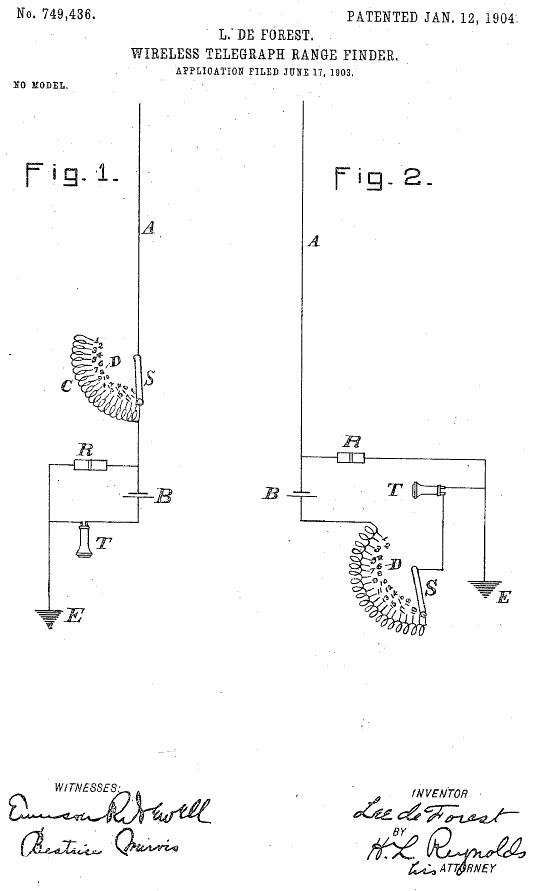
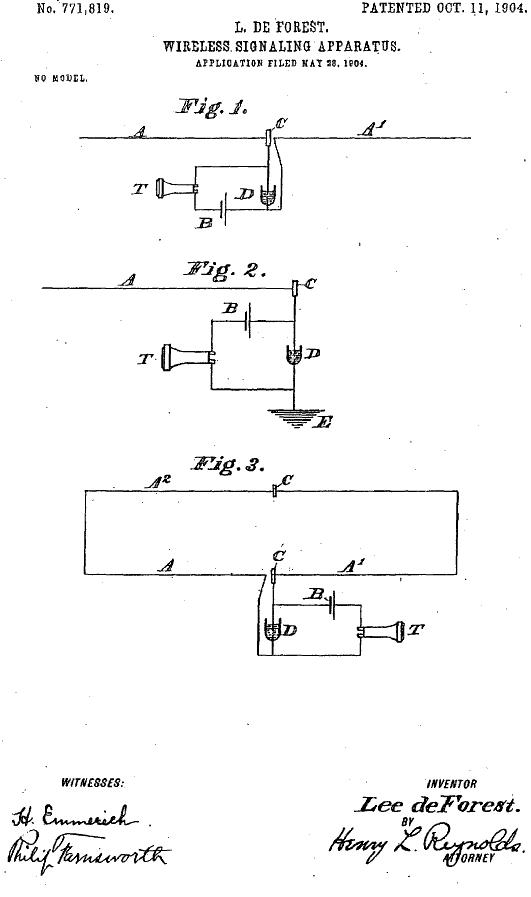
A prolific inventor, Lee de Forest not only invented some of the first direction finding (DF) antenna systems, but also deserves the credit for having invented the first RF ranging system. Realizing that signal strength declines with distance, de Forest proposed inserting a variable resistor into the RF circuit to enable a measurement of signal strength. Given a previously determined table of signal strength versus range, the range may be determined from this measurement of signal strength. [[1]] The Figure shows two embodiments of de Forest’s 1904 “Wireless range finder.”

Continue reading »

Jun 242010
 

John Stone Stone (1869-1943) patented the first effective direction finding system in 1902. [[1], [2]] Stone’s scheme involved a two element antenna with a first element (V) arranged no more than a half wavelength away from a second element (V’). The Figure below shows Stone’s invention. The two elements are arranged so that their respective signals add up 180 degrees out of phase with respect to each other. Thus, a signal incident in a direction normal to the plane containing the two elements their combined action is nil. Stone also embellished upon his invention in later years. [[3], [4]]

Continue reading »


Kitsee and Wilson’s US 651,014 (1900) direction finding antenna relied on shielding of a spherical capacitive end load to “shadow” signals.

Communications may have been the first commercial application of wireless technology, but Real-Time Location Systems (RTLS)  were close behind. In the first few years of radio, a variety of aggressive inventors recognized the problem of RTLS and leaped to offer solutions. Some of their ideas illustrated the inventors’ misunderstanding of the behavior of radio waves. Inventors assumed (erroneously) that long wavelength RF signals would cast sharp shadows in an optical fashion. Isidor Kitsee and Charles E. Wilson, for instance, proposed a spherically end-loaded antenna with a shield to block signals from a particular direction. [[1]] The Figure (left) shows the Kitsee-Wilson antenna.

Ladd’s US 733,910 (1903) direction finding antenna employed a rotating slit intended to allow the antenna to be illuminated only if the slit were aligned with a distant transmitter.

Hermon W. Ladd similarly proposed a whip antenna with a rotatable shield. [[2]] In Ladd’s proposed system, a narrow slit in a rotating shield is supposed to allow the antenna to be illuminated only when the slit is aligned with the direction of incidence of the signal. Both these DF antennas fail to work, because the low frequency signals (typically <300kHz) they aimed to detect have wavelengths too long (typically >1km) to be shadowed by such a small shield or to illuminate such a small slit. The Figure (right) shows Ladd’s direction finding system.

Continue reading »

© 2010-11 Hans Schantz except as noted. Suffusion theme by Sayontan Sinha

Switch to our mobile site