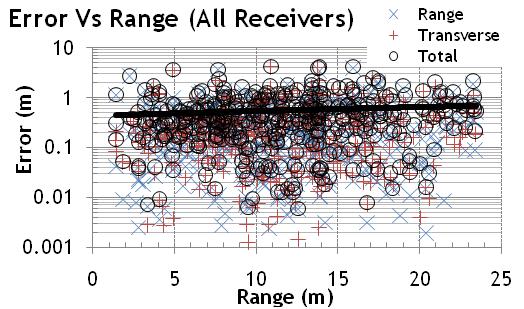
I’ll be presenting a poster, “Characterization of Error in a Near-Field Electromagnetic Ranging Real-Time Location System,” at the 2011 IEEE Radio and Wireless Symposium this afternoon at 13:30 in the Solano ballroom. My collaborators, John Unden, Chris Weil (now at Georgia Tech), and I collected and analyzed over four hundred individual measurements of a Near-Field Electromagnetic Ranging (NFER®) Real-Time Location System (RTLS). The system operated over ranges from 1.41m to 23.4m and the bulk of the points were taken “through wall” in a non-line-of-sight configuration. We found some interesting behavior:

  • Transverse and ranging error were comparable, 35.5cm and 34.4cm on average, for a total location error of 55.1cm on average. These error values are on a per receiver basis, and will tend to reduce by 1 / Sqrt(N) as measurements from N receivers are combined to yield a solution.
  • Error was only weakly range dependent (correlation or “r^2″ ~ 0.1). NFER® RTLS exhibits behavior analogous to a “capture effect” in which accurate tracking occurs wherever there is adequate SNR to support phase measurement.

Q-Track's NFER® RTLS yielded accurate tracking only weakly dependent on range.

  • Q-Track’s fifth generation NFER® RTLS yields location solutions accurate to within 1.2m 90% of the time.

Q-Track's fifth generation NFER RTLS yields location solutions accurate to within 1.2m 90% of the time.

This video illustrates the tracking capability of NFER® RTLS within the complicated RF propagation environment of a nuclear facility:


Steve Werner, Hans Schantz, and John Unden of Q-Track show off Q-Track's Firefighter Location And Rescue Equipment (FLARE) prototype. As usual, I'm standing around watching while Steve and John do all the work.

The Huntsville Times has a great write-up on Q-Track’s recent successful test of prototype Firefighter Location and Rescue Equipment (FLARE):

HUNTSVILLE, AL — Q-Track, a wireless tracking technology company in Huntsville, unveiled its firefighter location system prototype last week in Worcester, Mass., where six firefighters died in a warehouse fire in December 1999.

The company’s Firefighter Location and Rescue Equipment system was among tracking systems tested at an annual conference on indoor tracking for emergency responders. The test at the Worcester Polytechnic Institute was to find a “lost” firefighter in a simulated rescue exercise.

“We spent seven minutes finding the downed firefighter, the fastest rescue of the day,” said Steve Werner, Q-Track’s chief operations officer who took part in the Aug. 3 exercise with Worcester Fire Department personnel. He thought the best compliment after the operation came from one of the rescuers, who said, “Your system led us right to him.”

“It doesn’t get any better than that,” Werner said.

The rest of the story from the Huntsville Times, and previously on ÆtherCzar: Q-Track’s Firefighter Location System Succeeds in Trial and Precision Indoor Personnel Location and Tracking.

Follow Q-Track on Facebook here.


Q-Track COO, Steve Werner, and Director of Operations, John Unden have just finished another successful exercise of "find the tag" in demonstrations at the Fifth WPI Precision Personnel Locator Workshop Monday August 2. Q-Track's Firefighter Location and Rescue Equipment (FLARE) prototype went on to locate a fallen firefighter in a realistic exercise conducted by the Worcester Fire Department.

It was a busy couple of days at the 5th Annual Workshop “Precision Indoor Personnel Location and Tracking for Emergency Responders” at Worcester Polytechnic Institute in Worcester, MA. Q-Track (Facebook) unveiled our FLARE (Firefighter Location and Rescue Equipment) prototype system on Monday. Yesterday we participated in a realistic fire rescue exercise on the WPI campus with the Worcester Fire Department. Despite a GUI not fully mature, Q-Track’s FLARE system aided the Worcester FD team in making the fastest rescue of the day. But the workshop was more than just an opportunity for a realistic, real-world demonstration of firefighter location technologies.

Monday kicked off with some gripping stories of lost firefighters from Chief Billy Goldfeder, EFO, Deputy Chief, Loveland-Symmes FD, Ohio.  His website, firefighterclosecalls.com (Facebook) is a great resource for up-to-date firefighter news and information. One of the great benefits of the WPI Workshop to me as an RF scientist and developer of real-time locating solutions was the opportunity to learn about the real world of the first responder. I had not appreciated, for instance, that in the most critical tracking situations, firefighters will usually be crawling with absolutely no visibility.

Continue reading »

© 2010-11 Hans Schantz except as noted. Suffusion theme by Sayontan Sinha

Switch to our mobile site