I’ll be presenting a paper, “On the Origins of RF-Based Location,” at the 2011 IEEE Radio and Wireless Symposium this morning at 8:00 in room Cira A. The paper collects together the pre-WWII material I’ve blogged about under the History of RF-Based Location category here at ÆtherCzar.

This paper will provide a brief survey of the origins of RF-based location technology through the beginning of the Second World War. Direction finding (DF) was invented by John Stone Stone in 1902 and improved upon by Lee de Forest, Ettore Bellini and Alessandro Tosi. Both radar and amplitude ranging date to 1904, although these concepts were in advance of the ability of RF technology to implement. DF played a critical role in the First World War, most notably in the naval Battle of Jutland. The requirement for accurate night-time direction led classicist and cryptographer Frank Adcock to invent an improved DF system. In the 1920’s, DF and related concepts came of age for civilian applications like navigation. Inventors of the period introduced a variety of other techniques were introduced including time-of-flight or transponder ranging. By the time of the Second World War, DF was a mature field and additional novel RF-based technologies were ready to be developed.

In a second paper (not accepted by the conference) – “RF-based Location Technology Since World War II,” I present additional material. This second paper presents a brief historical overview of RF-based location technologies since the Second World War. Although direction-finding (DF) was critical to the Allied victory over German U-Boats in the north Atlantic, this paper focuses on more recent RF-based location technologies including Time-Difference of Arrival (TDOA), and ultra-wideband (UWB) technologies. More recent advances, including satellite navigation, RF fingerprinting, and near-field electromagnetic ranging technologies are also considered.

My presentation this morning will actually cover material from both papers.


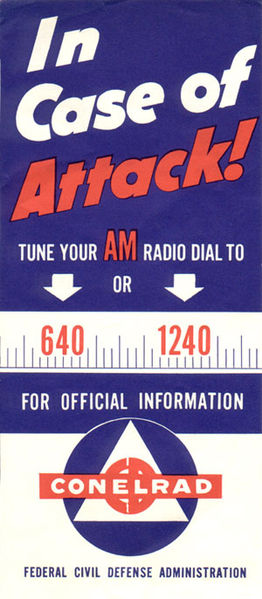
Direction-finding remained a leading RF-based real-time location system through World War II and beyond. As late as the 1960's, the U.S. imposed the "Control of Electromagnetic Radiation" or CONELRAD system to confound direction finding to AM broadcast stations while allowing them to continue relaying civil defense information. Source: Wikimedia.

High Frequency Direction Finding (HF/DF or “Huff-Duff”) played a critical role in the Second World War. Shore based DF determined the location of German U-boat packs enabling convoys to be routed around them. Ship and airborne DF in conjunction with centimetric radar enabled effective antisubmarine warfare. [1, 2] One of the leading pioneers in the British radar effort, Robert Watson-Watt (1892-1973), earlier devised an instantaneous reading goniometer that enable precise DF measurements, even on the short duration or burst signals employed by U-boats. [3]

The Japanese homed in on the signals of AM broadcast station KGMB on December 7, 1941 to help guide them to Pearl Harbor [4]. KGMB would not normally have been broadcasting in the early morning hours of Sunday December 7. Ironically, the station was broadcasting under a special contract to the Army Air Corp to help provide DF guidance to a flight of B-17 bombers due in from the mainland that same morning.

Fearing fleets of Soviet bombers might do the same, the US implemented “Control of Electromagnetic Radiation” (CONELRAD) in 1951. Under CONELRAD, in an emergency most AM stations would shut down. A few stations would broadcast civil defense information on 640KHz or 1240kHz in round-robin patterns intended to confuse enemy DF.  In addition, amateur radio operators were required to monitor a broadcast station at least once every ten minutes and stop transmitting if broadcast stations were not on the air. CONELRAD was abandoned in 1963 when it became evident that ballistic missiles, not bombers, were the real threat.


[1]     Robert Buderi, The Invention that Changed the World, (New York: Touchstone, 1996), pp. 165-169.

[2]    Peter J. Hugill, Global Communications Since 1844: Geopolitics and Technology, (Baltimore: Johns Hopkins University Press, 1999), p. 134-135, 146.

[3]    Robert A. Watson-Watt and J.F. Herd: “An Instantaneous Direct Reading Goniometer,” J. IEE (London), vol. 64, p. 11, 1926; also Wireless World vol. 18 p. 366, 1926.

[4]    Len Deighton, Blood, Tears, and Folly, (New York: Castle Books, 1993), p. 555.

© 2010-11 Hans Schantz except as noted. Suffusion theme by Sayontan Sinha

Switch to our mobile site