RTLS/RFID Update

 Posted by Hans at 05:12  No Responses »
Aug 282010
 

It’s been a busy week, so here is yet another RTLS/RFID update:


Last month, a Q-Track team traveled to the historic Safety Research Coal Mine in Bruceton, Pennsylvania to conduct RF propagation and performance tests on a Near-Field Electromagnetic Ranging (NFER®) Real-Time Location System (RTLS). We optimized the system for use in a mine environment in an effort funded by NIOSH. We deployed three receivers spaced 150-200 feet along a single passage and demonstrated accurate tracking in a 400ft x 100ft (40,000 sqft) area of the mine. The low frequency (575kHz) signals bend and diffract around corners, enabling accurate tracking in a parallel passageway substantially beyond line-of-sight of the three receivers in the primary passageway. This ability to obtain accurate tracking in non-line-of-sight environments is a hallmark of NFER® RTLS. Here’s a brief (82 second) clip showing the performance.


Back in July, a team from Q-Track Corporation traveled to Bruceton, PA, just outside Pittsburgh, to conduct RF propagation and performance tests on a Near-Field Electromagnetic Ranging (NFER®) Real-Time Location System (RTLS) optimized for use in a mine environment. The visit inspired this post about the history of the Bruceton Research Center.

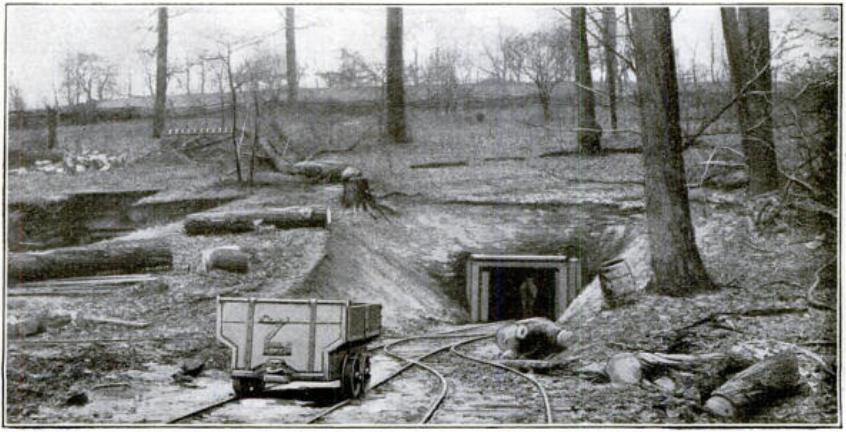
The Experimental Mine in Bruceton, PA began operations in 1910 according to the Wikipedia stub article. Popular Mechanics featured an article on the mine in 1911. [1] The aim of the Experimental Mine was originally to provide a test bed for improving mine safety, particularly as relates to safe use of explosives in coal mines.  An initial test in 1911 was witnessed by President Taft and other dignitaries. [2]

Experimental Mine, Bruceton, PA 1911. Source: Popular Mechanics, July 1911, p. 29.

By the 1920′s however, additional research was underway to explore how radio technology might be applied for mine communications and to direct rescuers in in mine emergencies. [3] Popular Science provided a comprehensive overview of research in a 1927 article. [4]

Many of the most recent technical reports – some of which describe modern work in the Experimental Mine, are available from the Mine Safety and Health Administration website. A much more detailed history is available from the CDC.

[1] “Coal Mine for Testing Explosions” Popular Mechanics, July 1911, p. 29-30.

[2] R. Dawson Hall, “The Explosion at Bruceton Mine,” Coal Age, November 11, 1911, pp. 149-152.

[3] G.E. Mitchell “Radio May Direct Rescuers in Mine Emergencies” The Wireless Age, January 1923, p. 55-56.

[4] M.E. Clements “Uncle Sam’s Toy Coal Mine,” Popular Science July 1927.

A Tale of Two Mines

 Posted by Hans at 17:43  No Responses »
Apr 252010
 

This interesting article from the NYT compares and contrasts the safety and business practices of the Upper Big Branch Mine with those of the nearby E3-1 Mine, run by TECO Coal Corporation. While the details on the culture and practice of mine safety are of technical interest, of greater interest to me is the contrast between business philosophies. One cut corners to maximize short term profits with tragic consequences. The other invested in training and safety to aim for long term success.  Hat tip: Paul Blair.

© 2010-11 Hans Schantz except as noted. Suffusion theme by Sayontan Sinha

Switch to our mobile site