Jun 072010
 

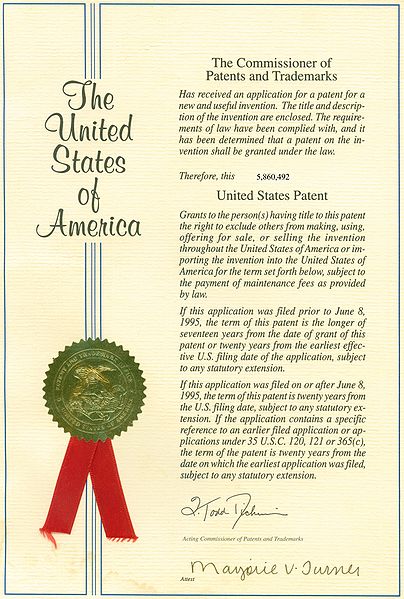
A U.S. Patent grants an inventor a monopoly on the manufacture, use, sale, or distribution of the covered invention for a period of twenty years from the date of filing - provided the inventor (or the inventor's assignee) pays the maintenance fees due 3.5, 7.5 and 11.5 years after the date of issue. Source: Wikimedia.

Congratulations! Your patent has issued and you have a twenty year monopoly on the sale, manufacture, use, or distribution of your cool new invention, right?

Not unless you pay your maintenance fees.

At the current fee levels, inventors must pay:

  • $980 ($490) due at 3.5 years after issue,
  • $2480 ($1240) due at 7.5 years after issue, and
  • $4110 ($2055) due at 11.5 years after issue

in order to keep the patent valid. The numbers in parentheses are the “small entity,” half-off rates that individual inventors and small businesses are charged. Fail to pay the maintenance fee within six months, and you lose your patent (barring some very difficult and expensive hurdles).

Now PatentlyO has a new post with historical data on issue fees, including a plot showing the percentage of patents for which the issue fees have been paid. Less than half of the patents issued in 1997 are still in force (i.e. have paid the third big maintenance fee installment). And in the current economy, the trend is downwards.

What surprises me is that the numbers are as high as they are. With so few patents actually worth anything, I might have expected more inventors and patent owners to cut their losses and skip the fee. But then again, given the burden and cost of getting the patent in the first place, inventors and patent owners are seriously tempted to throw good money after bad in hopes of preserving the chance to recover the patent’s value.

Hans

Hans Schantz is CTO of The Q-Track Corporation, and a co-inventor of NFER® technology. His prior work experience includes stints with IBM, the Lawrence Livermore National Lab, The ElectroScience Lab of the Ohio State University, and Time Domain Corporation. Author of The Art and Science of Ultra-wideband Antennas (Artech House, 2005), his thirty-five U.S. patents include antennas, RF systems, RF-based location systems, and related inventions. He is a Senior Member of the IEEE, and an amateur radio operator [KC5VLD]. Schantz earned his Ph.D. in physics from the University of Texas at Austin. He also holds degrees in Industrial Engineering and Physics from Purdue University. Dr. Schantz blogs at ÆtherCzar and is @ÆtherCzar on Twitter. His wife, Barbara, invented The Baby Dipper® Bowl. Hans and Barbara have two sets of twins: girls aged seven, and boys three years old. The views expressed are the author's and are not necessarily the views of his employer, clients, investors, sponsors, or customers.

 Leave a Reply

(required)

(required)

You may use these HTML tags and attributes: <a href="" title=""> <abbr title=""> <acronym title=""> <b> <blockquote cite=""> <cite> <code> <del datetime=""> <em> <i> <q cite=""> <strike> <strong>

   
© 2010-11 Hans Schantz except as noted. Suffusion theme by Sayontan Sinha

Switch to our mobile site