Previously, ÆtherCzar noted that the effectiveness of full body scanners has been called into question. Liquid explosives and other organic contraband contrast poorly and are said to be difficult to spot. These reports were largely anecdotal, however. Good technical information on the performance of x-ray backscatter full-body scanners has been hard to come by.
Recently however, two UCSF professors, Leon Kaufman and Joseph W. Carlson, completed a detailed analysis on the efficacy of these x-ray scanners. (As a potential point of interest, these are *not* the same UCSF faculty who wrote the letter to John Holdren previously mentioned here). Here’s the abstract of their paper:
Little information exists on the performance of x-ray backscatter machines now being deployed through UK, US and other airports. We implement a Monte Carlo simulation using as input what is known about the x-ray spectra used for imaging, device specifications and available images to estimate penetration and exposure to the body from the x-ray beam, and sensitivity to dangerous contraband materials. We show that the body is exposed throughout to the incident x-rays, and that although images can be made at the exposure levels claimed (under 100 nanoGrey per view), detection of contraband can be foiled in these systems. Because front and back views are obtained, low Z materials can only be reliable detected if they are packed outside the sides of the body or with hard edges, while high Z materials are well seen when placed in front or back of the body, but not to the sides. Even if exposure were to be increased significantly, normal anatomy would make a dangerous amount of plastic explosive with tapered edges difficult if not impossible to detect.
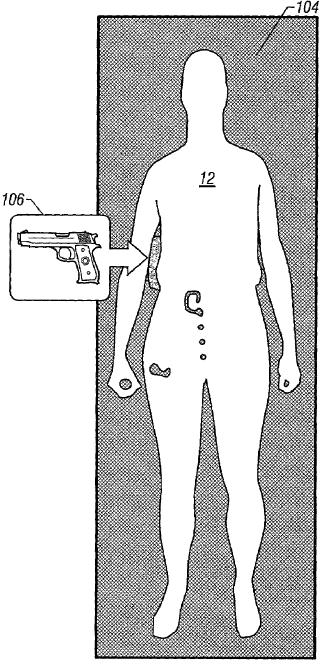
The authors point out that although high atomic number (“Z”) materials (like most metals) contrast strongly against the body, they can be hard to see against the side of the body. U.S. Patent 7,110,493 attempts to remedy this problem by placing a low Z panel behind the body (see figure).
Most explosives are organic with an average atomic number close to that of the human body. The x-ray scanner is thus trying to spot a very subtle difference in contrast. X-ray scanners not only “probe” the surface layer of skin but also penetrate some distance below. What they see is an average of the first couple centimeters or so of your body. That’s why ghostly shins and kneecaps tend to show up in the x-ray backscatter images. The calcium (Z = 20) in the bones (effective Z ~ 13) near the surface contrasts against generic tissue (Z ~7.6). The authors also point out that a pancake of explosives with a beveled or tapered edge and thus a gradual transition in atomic number will blend into the the background tissue making it virtually impossible to detect.
Given these vulnerabilities, I’m surprised the concept of operation for the x-ray backscatter units hasn’t been modified to require “side” scans in addition to the front-back scans. If the body were rotated ninety degrees, the high-Z gun hidden under the arm (as in the figure) would be clearly contrasted against the body, and the low-Z pancake would have less opportunity to blend into the body. But then that would double the radiation dose.
The good news from this study is that images can be made from the low (and probably safe) levels of radiation cited by the manufacturers. There had been some speculation that higher exposure levels were needed to get decent images. The bad news is that x-ray backscatter units – as currently deployed and used – have some serious vulnerabilities.
Hat tip: BoingBoing (Cory Doctrow) – Pornoscanners trivially defeated by pancake-shaped explosives (via Matt).
Previously on ÆtherCzar:
- How Full-Body Scanners Work – and Fail an overview of body-scanner technology, both x-ray and millimeter wave.
- How X-Ray Backscatter Full-Body Scanners Work an examination of the relevant patents to see how X-ray scanners function.
- Are Backscatter X-Ray Scanners Harmful? and Latest on X-Ray Backscatter Safety look at the safety of c-ray scanners.
- X-Ray Backscatter or Millimeter-Wave: Can You Tell the Difference? provides a tutorial on how to tell the difference between x-ray and millimeter wave images.
- ÆtherCzar has provided three collections of updates and links.
- Finally, ÆtherCzar passed on A Comprehensive Update on Body Scanners from Bruce Schneier and Bruce Schneier Interview – Security Theater and the TSA – Popular Mechanics.
Update: Here’s Ars Technica’s take.


One thought on “Technical Analysis of X-Ray Backscatter Units’ Performance”