This insightful piece from the Huffington Post describes how the friendship of electrical pioneer Michael Faraday and landscape artist J.M.W. Turner influenced Turner’s work - Mario Livio: When Science Met Art.


Here’s more good press for NFER® RTLS pioneer, Q-TrackNuclear Engineering International reports:

Workers in six US nuclear power plants are being trained in a virtual radiation environment so that they can develop skills to keep radiation exposures low.

The Q-Track radiation worker training system combines a software program that can be used to define a virtual radiation zone with an indoor wireless tracking system that monitors trainees’ movements. When a trainee approaches a ‘virtual’ radiation source within the simulated radiation environment they will receive a realistic dose, rate and alarm from their simulated electronic dosimeter. Q-Dose also tracks the cumulative dose incurred during the training process. Software can be used to record the trainees’ responses, creating a radiation trail mapping their movements. Instructors can later replay this location, dose and rate data so that trainees can review and critique their performance.

This video shows the Q-Track Dosimulation™ system in action:

Southern Company’s Plant Vogtle won a Top Industry Practice or “TIP” Award from the Nuclear Energy Institute for piloting the Dosimulation™ system. For more information, visit the Q-Track website.


Employing Q-Track’s patented Near-Field Electromagnetic Ranging (NFER®) technology, Collision Avoidance Non-Line-of-Sight (CANLOS™) systems allow robots to detect and avoid colliding with their human co-workers even when when direct line-of-sight may be blocked. NFER® signals use low frequencies that penetrate better and diffract around obstructions that may block conventional RF and optical sensors. This non-line-of-sight behavior makes NFER® products well-suited for use in complicated industrial settings.

How CANLOS Works

A leading manufacturer of innovative motion control and automation equipment for industry, CAMotion, uses Q-Track’s CANLOS™ System to provide non-line-of-sight awareness to robotic cranes, helping them to stop safely before colliding with their human co-workers. RFID Journal recently described the successful system in a feature story:

CAMotion is providing the CANLOS system—as redundancy to its laser-based collision-avoidance technology—to a magazine printing firm that utilizes automated cranes to move large stacks of paper, known as logs. The CANLOS system has been installed at 15 locations throughout the United States, according to Alex Furth, CAMotion’s CEO, with six additional sites slated to go live during the next few months. 

Workers wear a QT-600 Tag Transmitter that not only allows the CANLOS™ receiver to detect their proximity, but also supports real-time location awareness in a more general NFER® Real-Time Location System (RTLS). The RFID Journal article explains how Q-Track’s CANLOS™ system works in detail:

A Q-Track QT600 RFID transponder, worn on a belt clip, beacons a unique ID number at predetermined intervals—typically, 10 times per second. The RFID receiver is installed on the crane’s gripper (the claw that picks up an item), which measures about 45 inches in length and 9 inches in width. The crane itself usually moves at the speed of a typical fast walk. When the gripper comes within about 8 feet of an individual’s transponder, the receiver determines that a collision is possible. The CAMotion software, loaded on the machine’s onboard computer, then instructs the crane to halt, which takes approximately 1.5 seconds to occur once the transmission has been received.  

Here’s a close-up of the CANLOS™ receiver installed on the crane’s gripper:

Close-up view of Q-Track's Proximity Detection System (CANLOS) (courtesy CAMotion and RFID Journal).

And here’s a view of the system in a magazine printing facility:

Q-Track's CANLOS system helps CAMotion's robotic cranes to detect and avoid their human co-workers in this magazine printing facility (courtesy CAMotion and RFID Journal).

For more information, see these additional links:


Q-Track’s A-Team traveled to upstate New York the other day to show off NFER RTLS for tactical training at Tactical Conference 2012. Here’s the press release:

May 01, 2012 - 
Verona, NY – Q-Track Corporation, the pioneer in Near-Field Electromagnetic Ranging, will demonstrate NFER Real-Time Location Systems (RTLS) products in and around Booth 515 at Tactical Conference ‘12  today through May 3 at Turning Stone Resort in Verona, NY.

The high accuracy and low cost of  NFER RTLS products allow Q-Track’s Dosimulation™ Systems to provide unprecedented realism in simulated dosimetry and radiation worker training. Now NFER RTLS is available in products suitable for Military Operations Urban Terrain (MOUT) training or for other tactical training applications indoors, underground, or anywhere GPS is not available. NFER RTLS may be deployed as a stand-alone system in support of after-action reviews, or integrated for use in other training systems.

In a demonstration at a MOUT training range, Q-Track deployed four QT-550 Locator-Receivers to track tags to a typical accuracy of 30cm-1m within a 50m x 50m (165ft x 165ft) city block, including in and around three buildings.  A video is available below:

About Tactical Conference 2012:  Sponsored by the New York Tactical Officers Association (NYTOA) and New York Association of Hostage Negotiators, the 6th annual Tactical Training  Conference and Exposition is a culmination of what the NYTOA is all about: training, sharing  information, and networking with peers and companies who make tactical officers’ jobs safer and more effective. The program brings together an exceptional instructor cadre, conference training agenda, and vendor show. Visit http://www.nytacticalexpo.com/ for details.

About Q-Track and NFER RTLS: Q-Track, a privately held company located in Huntsville, AL, has been pioneering NFER technology since 2002. Q-Track’s NFER technology is the basis of the Dosimulation system piloted at Southern Company’s Plant Vogtle nuclear facility. RFID Journal recognized the breakthrough nature of Q-Track’s innovative NFER RTLS offering with a “Best-In-Show, Finalist,” designation for the third annual RFID Journal Awards. The Nuclear Energy Institute awarded Southern Company the 2010 Top Industry Practice (TIP) Award for Training for their use of Q-Track’s NFER RTLS-based “Dosimulation” system. Q Track’s NFER RTLS is also employed in a proximity detection system and other location awareness products. For more information, visit the company’s website at http://www.q-track.com. “NFER” “Dosimulation” and “Q-Track” are trademarks or registered trademarks of the Q-Track Corporation.


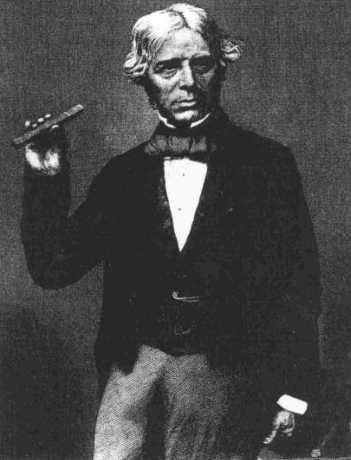
Michael Faraday (1791-1867) devised the concept of electric and magnetic fields and discovered the principle of induction which makes possible electric motors and generators (image courtesy, Wikimedia Commons).

Any student of electromagnetics knows the story – Michael Faraday devised the ingenious concept that electric and magnetic effects were due to “fields” pervading space. Applying this simple concept, he was able to devise and demonstrate the phenomenon of induction, discovering the physics that gives rise to electric motors and generators. Faraday’s fundamental insight inspired James Clerk Maxwell who, a generation later, cast Faraday’s nebulous field conception in rigorous mathematical form. By so doing, Maxwell predicted the existence of electromagnetic waves – the properties of which Hertz  established and proved yet another generation later.

As usual, there’s more to the story.

One hundred eighty years ago today, on March 12, 1832, Faraday wrote a secret letter predicting the existence of electromagnetic waves. Faraday submitted his letter to the Secretary of the Royal Society of London where it lay for over a century in a strong box. The letter only came to light when it was opened by Sir William Bragg on June 24, 1937. The only online publication of this letter in its entirety appears to be in Google Book results such as for Garratt’s The Early History of Radio, the text in which I found it, or in journal articles behind pay walls. Faraday’s magnificent foresight deserves more attention than it has thus far received,  so I’m delighted to share Faraday’s letter in full, after the break.

Continue reading »

Feb 222012
 

Today's Google Doodle honors Heinrich Hertz on the 155th anniversary of his birth.

Today’s Google Doodle honors Heinrich Hertz (1857-1893), discoverer of radio waves, on the 155th anniversary of his birth.

Heinrich Hertz was not the first to experiment with radio waves. Contemporaries such as Charles Hughes and Oliver Lodge performed similar work in parallel. What set Hertz apart, however, was his tenacity in teasing out the properties of electromagnetic waves from the brilliant use of crude instrumentation – up to and including attempting to use frog legs as RF detectors. Hertz further provided a comprehensive theoretical framework for understanding radio waves. Among Hertz’s antenna discoveries were the half-wave dipole, end-loaded dipole, and the parabolic reflector. He also employed loop antennas. Hertz also first worked out the near-field physics that makes Q-Track’s NFER® Real-Time Location Systems possible.

One of the best summaries of Hertz’s work I’ve seen may be found in Glenn S. Smith’s An Introduction to Classical Electromagnetic Radiation. But really, every student of electromagnetism and antennas ought to read the master straight from the source, his Electric Waves, published in 1893.

Hertz accomplished more in his all-to-short life than most, and I applaud Google for honoring the debt we all owe him.


I’m passing on another press release from my company, Q-Track. The Q-Track team at I/ITSEC is having a great show and wanted to share this video, filmed yesterday, of their live demonstration.

ORLANDO, FL – December 1, 2011. Q-Track’s NFER Real-Time Location System (RTLS) demonstration wowed attendees during the first days of I/ITSEC 2011 — the world’s premier modeling, simulation, and training conference. Q-Track’s live NFER RTLS demonstration tracked not just within Q-Track’s booth, but also throughout the adjacent area. NFER or “Near-Field Electromagnetic Ranging” exploits the near-field physics of low frequency signals to deliver highly accurate real-time tracking at substantial ranges, even in difficult non-line-of-sight environments. The real-time updates, low latency, and low cost have drawn particular praise. In addition to U.S. attendees, visitors from the UK, China, Belgium, Sweden, Canada, the Czech Republic, and Israel all witnessed the demonstration. Today, December 1, is the last opportunity to see the demonstration live at Booth #2737, but a video is available at this link.

NFER RTLS is available in products suitable for Military Operations Urban Terrain (MOUT) training or for other training applications indoors, underground, or anywhere GPS is not available. The Q-Track system may be deployed in a stand-alone fashion in support of after-action reviews, or integrated for use in other training systems.

About Q-Track and NFER RTLS: Q-Track, a privately held company located in Huntsville, AL, has been pioneering NFER technology since 2002. Q-Track’s NFER technology is the basis of the Dosimulation system piloted at Southern Company’s Plant Vogtle nuclear facility. RFID Journal recognized the breakthrough nature of Q-Track’s innovative NFER RTLS offering with a “Best-In-Show, Finalist,” designation for the third annual RFID Journal Awards. The Nuclear Energy Institute awarded Southern Company the 2010 Top Industry Practice (TIP) Award for Training for their use of Q-Track’s NFER RTLS-based “Dosimulation” system. Q Track’s NFER RTLS is also employed in a proximity detection system and other location awareness products. For more information, visit the company’s website at www.q-track.com. “NFER” “Dosimulation” and “Q-Track” are trademarks or registered trademarks of the Q-Track Corporation.


Next-RF’s Model 310C UWB Planar Horn Antenna is now available from Amazon. This ultra-wideband (UWB) antenna approximates a constant aperture. Thus, the time domain voltage signal closely approximates the time domain behavior of the incident fields themselves. In addition to use as a UWB impulse antenna, this antenna provides a low cost alternative to ridged horns and other EMC or spectrum analysis antennas. Additional details on the performance of the Model 310C UWB Planar Horn Antenna are available in a previous blog post. Many thanks to the Czarina for including this UWB offering in her line of children’s feeding products.


Q-Track is demonstrating NFER® RTLS in and around Booth 2737 at I/ITSEC 2011, the world's premier modeling, simulation, and training conference, in Orlando, FL today, November 28, through December 1.

Today, I’m passing along a press release from my company, Q-Track. Swing by Booth 2737 at I/ITSEC in Orlando this week to see a demonstration of NFER RTLS.

ORLANDO, FL – November 28, 2011. Q-Track Corporation, the pioneer in Near-Field Electromagnetic Ranging, will be demonstrating NFER Real-Time Location Systems (RTLS) products in and around Booth 2737 at I/ITSEC 2011 — the premier modeling, simulation and training conference — today through December 1 in Orlando.

The high accuracy and low cost of  NFER RTLS products allow Q-Track’s Dosimulation™ Systems to provide unprecedented realism in simulated dosimetry and radiation worker training. Now NFER RTLS is available in products suitable for Military Operations Urban Terrain (MOUT) training or for other training applications indoors, underground, or anywhere GPS is not available. NFER RTLS may be deployed as a stand-alone system in support of after-action reviews, or integrated for use in other training systems.

In a demonstration at a MOUT training range, Q-Track deployed four QT-550 Locator-Receivers to track tags to a typical accuracy of 30cm-1m within a 50m x 50m (165ft x 165ft) city block, including in and around three buildings.  A video is available below:

About Q-Track and NFER RTLS: Q-Track, a privately held company located in Huntsville, AL, has been pioneering NFER technology since 2002. Q-Track’s NFER technology is the basis of the Dosimulation system piloted at Southern Company’s Plant Vogtle nuclear facility. RFID Journal recognized the breakthrough nature of Q-Track’s innovative NFER RTLS offering with a “Best-In-Show, Finalist,” designation for the third annual RFID Journal Awards. The Nuclear Energy Institute awarded Southern Company the 2010 Top Industry Practice (TIP) Award for Training for their use of Q-Track’s NFER RTLS-based “Dosimulation” system. Q‑Track’s NFER RTLS is also employed in a proximity detection system and other location awareness products. For more information, visit the company’s website a www.q-track.com. “NFER” “Dosimulation” and “Q-Track” are trademarks or registered trademarks of the Q-Track Corporation.


I came across the following by Vannevar Bush, and thought I’d pass it along. This is one of the clearer descriptions of how electromagnetic energy works that I’ve run across.

In fact, the very definition of the radiation during a transient is a matter of some concern. Radiation in the steady state is easily defined. When steady alternating potential and currents exist in a circuit, they are accompanied by steady electrostatic and electromagnetic fields surrounding the circuit. These fields constitute a storage of energy. When a field collapses, the stored energy largely returns to the circuit, but not all of it returns. Some of the energy stored in one half-cycle does not return during the next half-cycle. This residual of energy is the energy of the radiated wave, which proceeds out from the circuit at the speed of light. The power radiated from a circuit in the steady state is the energy lost per second in this manner.

[Commenting on Charles Manneback, “Radiation from Transmission Lines,” Transactions of the American Institute of Electrical Engineers, Vol. 42, Feb. 1923, pp. 289-301.  Behind  IEEE paywall here. See p. 300.]

© 2010-11 Hans Schantz except as noted. Suffusion theme by Sayontan Sinha

Switch to our mobile site