
Amazon hasn’t linked everything together yet, but the paperback and ebook editions of The Brave and the Bold are up now: ebook: https://amzn.to/2qeB4Ix paper: https://amzn.to/2CLJezU The rest of the Hidden Truth series is on sale for $0.99, and all the ebooks are free through Kindle Unlimited. Here’s the blurb: Where we go […]
Books
95 posts

Fenton Wood’s Pirates of the Electromagnetic Waves is an amazing young adult techno-adventure reminiscent of Bertrand R. Brinley’s classic Mad Scientists Club (my review here). Set in an alternate universe nostalgically reminiscent of mid-century America, Wood tells the story of a boy and his young friends as they struggle to build […]
The Brave and the Bold is now uploaded and on Amazon’s servers. Clocking in at over 400 pages and more than 120,000 words, it’s the sequel Hidden Truth fans have been waiting for. That larger size drove an increase in the paperback price. The Hidden Truth and A Rambling Wreck […]

The updated covers are now available for the first two books in the Hidden Truth series. Book 3: The Brave and the Bold, will be released in a couple of weeks. Thanks to Steve Beaulieu of Beaulistic Book Services for the new book cover designs.

Thought I’d share the news that my science fiction alternate history conspiracy thriller, A Rambling Wreck, will be on sale for $0.99 for the next couple of weeks. Here’s an excerpt from John Walker’s recent review of A Rambling Wreck: This series is a bit of Golden Age science fiction which […]
This week, The Hidden Truth will be on sale for $0.99, so it’s a good time to take a look at some of the amazing reviews my science fiction techno-thriller continues to collect. Writing at Ratburger, John Walker had this to say: This is a masterpiece of alternative history techno-thriller […]

I’ve been talking with some great folks about science fiction in general and my works in particular. Here’s a list of recent podcast appearances: Catholic Geeks/Declan Finn (November 27, 2016) – I discuss The Hidden Truth and other topics with host, Declan Finn. Catholic Geeks/Declan Finn (June 25, 2017) – […]
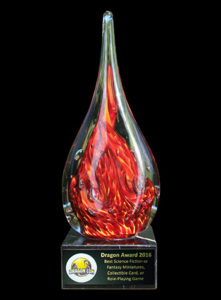
I regret being too busy to keep better track of the amazing quantity of fantastic science fiction from the last year. There’s a wealth of great material out there, though, and by selecting the works you found of particular value, you can help bring them to the attention of other […]
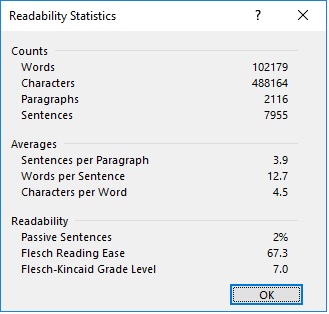
Microsoft Word can analyze a document for readability. You can access this feature through the menu path File> Options> Proofing> Show Readability Statistics. Then you have to suffer through a complete spelling and grammar scan of your document before you get rewarded with feedback at the end of the process. […]
I managed to get A Rambling Wreck completed in time for a launch at LibertyCon on July 1, but that left no time for blog updates. I’ve updated my website with a page dedicated to A Rambling Wreck. The initial sales have been strong, and the reviews favorable. I’ll publish […]
I’m taking a moment away from working on my draft of A Rambling Wreck to share with you the latest Amazon review of The Hidden Truth, courtesy of Steve D. Poling: If Al Gore Had Won Steve D. Poling My first impression of The Hidden Truth was how much it reminded […]

It’s time for the October Booknado from the Conservative Libertarian Fiction Alliance! The organizers even let me in again with my book on the biographies of John Charles Fremont, but I wouldn’t hold that against their other outstanding selections! Best of all, when you buy using these links, you support […]
It’s time for the September Booknado from the Conservative Libertarian Fiction Alliance! I haven’t read all of these but I was impressed with last month’s selections – including The Hidden Truth! Best of all, when you buy using these links, you support CLFA through the Amazon affiliate program: NEW RELEASES […]

A couple of weeks ago, I traveled to the UK to attend the Logistics Research Network Conference and present some talks. One, presented at the James Clerk Maxwell Institute and Newcastle University, explained my ideas on energy in reactive fields. The kind folks at Newcastle University have posted a video […]

The Communications Research Group at the University of Hull graciously invited me to speak on the subject of “Near-Field Wireless Technology.” My hosts inform me that the seminar will start with refreshments, posters and informal discussion from 2.00pm with a 2.30pm start for the main seminar. We should finish about […]
It’s like Conan the Barbarian meets Dilbert. Conan hurled the severed head into the center of the room. “A warning to anyone else who tells me I have a case of the Mondays!” he roared. — Conan the Salaryman (@ConanSalaryman) August 29, 2016 Every workday, Conan The Salaryman provides status […]
I’m pleased to announced a special offer for ÆtherCzar readers and fans, courtesy of my publishers at Artech House.The Art and Science of Ultrawideband Antennas is now available at a 25% discount direct from the publisher: For my US readers: $103 discounted from the regular $139 price For my UK readers: […]

You can read my science fiction thriller, The Hidden Truth, and a host of other great science fiction and fantasy works for free when you sign up now for Kindle Unlimited through Amazon. Amazon will give you a free thirty-day trial of Kindle Unlimited. If you continue in Kindle Unlimited […]
Never start a land war in Asia. Never go in against a Sicilian when DEATH is on the line. Now I need to add another to the list: never submit a post on grammar Nazis to a subredit full of real-life grammar Nazis. I confused “capitol” for “capital” and “composed” […]

YASIV is a visual recommendation service that helps people find the right product from Amazon’s catalog by examining the connection to related products, as determined by common purchases. A link between the two products means that they are often bought together. By simply observing the network of products one can […]

Over the weekend, Drudge linked to this sensational click-bait article from the Daily Mail (click image for link): Can all of storytelling be broken down into six and only six basic classifications? Are there secret story structures that will enhance the success and popularity of an author’s narrative? The answers […]

Hidden deep within the heart of London is a humble facade on St. James’s Square leading to 17 miles of bookshelves distributed through seven conjoined buildings. The London Library was born 175 years ago. One of the world’s largest independent lending libraries, The London Library never throws away any books, […]
Dilbert cartoonist turned political commentator, Scott Adams, shares his unconventional creative wisdom in this fascinating keynote address at the Haas School of Business at the University of California, Berkeley. You’ll find Adams’ latest blog posts in my blog roll. And if you don’t like his talk, you probably won’t appreciate […]
I prepared the following as an exercise in proofreading for job candidates at Q-Track. Then it got a bit out of hand. Judge for yourself. I haven’t had the heart to inflict this on any poor unsuspecting applicants, and probably never will. Thinking it unfair to hoard the fun all […]